 Stiff Hips from Sitting All Day? Causes and 6 Simple Stretches
If the first few steps after you stand up feel creaky — like your hips need a moment to unfold — you're not imagining it. Hours in a chair leave the front of your hips shortened and the back of them half asleep, and over weeks and months that temporary stiffness can start following you around: into your walk, your lower back, even your knees. The good news is that hips respond quickly. A few targeted stretches, done briefly and often, undo most of what a desk day does. Here's why it happens, and the six moves that help most.
Why Sitting Makes Your Hips Stiff
Your hip flexors — the muscles running from your spine and pelvis to the front of your thigh — spend the whole working day in a shortened position while you're seated. Muscles adapt to the position they're held in, so day after day of shortening leaves them feeling tight the moment you ask them to lengthen again, like when you stand up and walk.
Meanwhile, your glutes — the powerful muscles at the back of the hip — do almost nothing in a chair. Underused muscles get reluctant: they don't fire as readily when you climb stairs or walk uphill, so smaller muscles in your back and legs pick up work they weren't designed for. That's one reason stiff hips and a grumbly lower back so often arrive together.
The joint itself likes variety, too. Hips are built to move in big circles — forwards, back, sideways and rotating — but a chair only ever asks for one fixed angle. Motion is what keeps a joint feeling free, and sitting delivers very little of it.
None of this is damage. It's deconditioning, and it reverses: short, regular stretching tells the front of the hip it's allowed to lengthen again, and simple strengthening wakes the back of the hip back up.
1. Half-Kneeling Hip Flexor Stretch
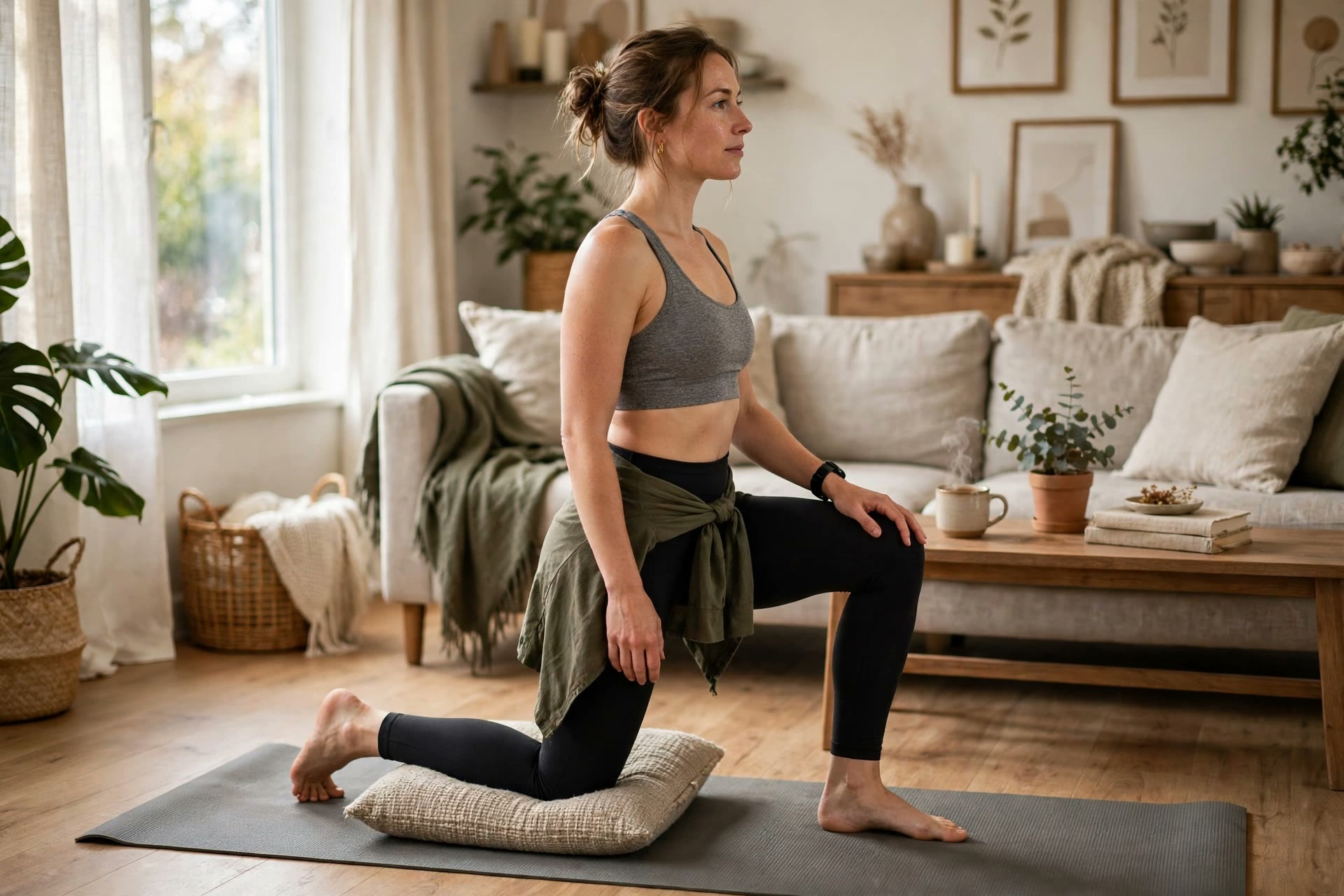
This is the headline act, because it targets the exact muscles that are shortened. Kneel on one knee — use a cushion under it — with the other foot flat in front, like a lunge on the floor. Tuck your tailbone slightly under and gently shift your weight forward until you feel a stretch at the front of the hip and thigh of the kneeling leg.
Hold for 30 to 60 seconds, breathing slowly, then swap sides. Two rounds each side is plenty. The tuck matters: if you skip it and just lean forward, you'll mostly arch your lower back instead of stretching the hip.
2. Figure-Four Stretch for the Outer Hip
The deep muscles at the back and outside of the hip — including the piriformis — get cranky from sitting too, and they respond to a completely different angle. Lying on your back, cross one ankle over the opposite knee and gently draw the uncrossed leg toward your chest until you feel a deep stretch in the buttock of the crossed leg.
Hold 30 to 60 seconds per side. You can also do this seated: ankle on knee, sit tall, and hinge forward from the hips with a straight back until the stretch arrives. Keep it at a comfortable pull — never force the knee down.
3. 90/90 Hip Rotations
Stretching lengthens muscles; this one reminds the joint itself how to rotate. Sit on the floor with both knees bent at roughly right angles, one leg in front of you and one behind, both shins on the floor if you can manage it. Sit as tall as you can for 30 seconds, then flip both knees to the other side like windscreen wipers.
If the full position is too much at first, prop yourself up with your hands behind you and work through whatever range you have. Two to three minutes of slow flips teaches your hips more about moving freely than any single static stretch.
4. Standing Leg Swings
This is the desk-friendly one — no floor, no mat, done in a minute beside your chair. Hold the desk for balance and swing one leg gently forwards and backwards like a pendulum, keeping your torso still and letting the movement come from the hip. Twenty swings, then twenty side to side across the front of your body, then swap legs.
Start small and let the swing grow as the hip loosens. It's a simple way to pump movement through the joint in the middle of the day, exactly when sitting is doing its stiffening work.
5. Break Up the Sitting Itself
No stretch fully cancels eight unbroken hours in a chair, so shrink the dose. Stand up every 30 to 60 minutes — the same rhythm that helps your back — and give your hips a job while you're up: a short walk, a few stairs, or ten slow sit-to-stands from your chair.
Chair height plays a part too. If your hips sit noticeably lower than your knees, your hip flexors start the day extra shortened; raising the seat so your hips are level with or slightly above your knees gives them a fairer starting point.
6. Wake Your Glutes Back Up
Stretching handles the tight front; strengthening handles the sleepy back. Glute bridges are the simplest start: lying on your back with knees bent, push through your heels and lift your hips until your body forms a straight line from knees to shoulders, squeeze for two seconds at the top, and lower slowly. Two sets of ten, a few times a week.
Sit-to-stands work too, and they fit a workday: stand up from your chair without using your hands, sit back down with control, repeat. As your glutes take their share of the load again, your hips usually feel less stiff — because they're no longer being pulled around by an uneven team.
Frequently Asked Questions
Why do my hips feel stiff when I first stand up?
While you sit, your hip flexor muscles are held in a shortened position, and the joint sits at one fixed angle for hours. When you stand, those muscles need a moment to lengthen again — hence the creaky first few steps. It usually eases within a minute or two of walking.
How long does it take to loosen stiff hips?
Most people notice the standing-up stiffness easing within one to two weeks of short daily stretching. Deeper, long-standing tightness takes longer — think six to eight weeks of consistency. Brief and daily beats long and occasional.
What is the best stretch for tight hip flexors?
The half-kneeling hip flexor stretch is the most direct: kneel on one knee, tuck your tailbone slightly, and shift gently forward until you feel the stretch at the front of the hip. Hold 30 to 60 seconds each side, twice.
Can stiff hips cause lower back or knee pain?
They can contribute. When hips don't move freely, the lower back often twists and bends more to compensate, and the knees can take uneven loads when you walk. Loosening and strengthening the hips is a sensible first step — but persistent pain deserves a professional assessment.
When should I get my hip checked?
See a professional if you have groin pain that won't settle, a clicking or catching sensation with pain, stiffness that's much worse on one side, pain after a fall, or stiffness that keeps progressing despite a few weeks of regular stretching and movement.
This article is for general information only and isn't medical advice. If you're dealing with persistent or severe hip pain, check in with a qualified health professional.
Browse our braces and supports collection for hip supports, cushions, and stretching aids.
